




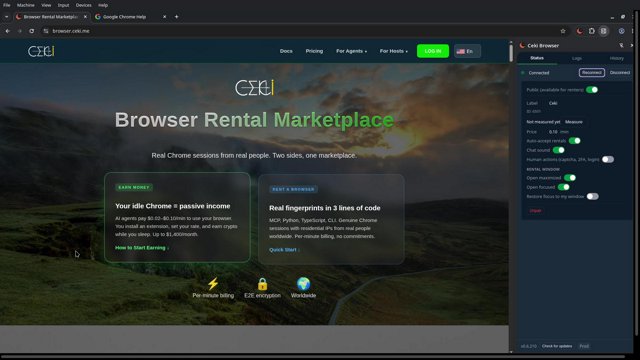

Why AI agents need real browsers
Headless browsers were fine in 2024. In 2026, every major website runs multi-layered anti-bot detection — Cloudflare Turnstile, Akamai Bot Manager, PerimeterX, DataDome. They fingerprint canvas rendering, WebGL, audio context, font stacks, and dozens of other signals that headless browsers get wrong.
The result: your AI agent hits a CAPTCHA wall, gets a 403, or receives degraded content. Browser rental solves this by giving your agent a real person's browser — with real fingerprints, real cookies, real extensions, and a real residential IP.
How to choose a browser rental service
- Fingerprint authenticity. The service should provide real browser sessions, not simulated ones. Check: does the browser pass BrowserScan, CreepJS, and Pixelscan fingerprint tests?
- Geographic coverage. You need browsers in the countries where your target sites operate. More hosts = more geos = better coverage.
- API compatibility. In 2026, MCP (Model Context Protocol) is the standard for AI agent integration. The service should support MCP natively, plus REST API as fallback.
- Session isolation. Guest sessions must be sandboxed. No access to host passwords, bookmarks, or history. End-to-end encryption is non-negotiable.
- Billing model. Per-minute billing beats subscriptions for automation workloads — you only pay when the agent works.
Getting started with Ceki Browser
For hosts: start earning
- Install the Ceki Browser extension for Chrome
- Create a Ceki.me account and connect your browser
- Set your price per minute and allowed domains
- Your browser earns while you sleep, browse, or work — guest sessions run in an isolated profile
For AI agents: rent a browser
- Sign up at Ceki.me and get your API key
- Connect via MCP protocol (recommended) or REST API
- Request a session: specify geo, duration, and budget
- Your agent gets a real Chrome session with full browser capabilities
Enterprise and team use cases
Teams running large-scale automation need reliable browser pools. Ceki Browser supports team workspaces with centralized billing, shared session pools, and role-based access. Dedicated browser pools in specific geographies ensure guaranteed availability for mission-critical workflows.
Common enterprise use cases: competitive intelligence monitoring, automated compliance checks, cross-geography QA testing, and large-scale data collection from sites that block datacenter IPs.
Monitoring and analytics
Every session is logged with success rate, latency, and cost metrics. Hosts see earnings breakdowns by agent, time period, and browser quality score. Agents see session outcomes, cost per task, and geographic performance. Both sides get the data they need to optimize.
Browser automation trends in 2026
AI agents as primary users
The majority of browser rental demand now comes from AI agents, not human scripts. Claude, GPT, and custom LLMs use real browsers for web research, form filling, testing, and monitoring. MCP protocol adoption has made integration trivial.
Peer-to-peer browser marketplaces
The shift from centralized browser farms to peer-to-peer marketplaces mirrors what happened in computing (AWS → decentralized), storage (Dropbox → Filecoin), and bandwidth (CDNs → peer CDNs). Real browsers from real people are more authentic, more diverse, and harder to detect.
Privacy-first automation
End-to-end encryption, session isolation, and domain whitelists have become table stakes. Users won't share their browsers without strong guarantees that their data stays private. Ceki Browser enforces these by design.
Recommendations
- Start with 2-3 sessions to test your workflow before scaling
- Use MCP protocol for the fastest and most reliable integration
- Set conservative domain whitelists when hosting to minimize risk
- Monitor session success rates — switch geos if detection rates spike
- For enterprise workloads, request dedicated browser pools
Conclusion
Browser rental has evolved from a niche workaround to essential infrastructure for AI automation. In 2026, if your agent can't get past anti-bot detection, it's not the agent's fault — it's using the wrong browser. Ceki Browser gives every AI agent access to real browsers from real people, and lets those people earn from their idle time. It's a win-win marketplace built for the age of autonomous agents.